

Customer Service Hotline:
+8613261677119
+8613261677119
Wireless Alarm and Strobe Devices for Retrofit Projects | Wanlin Fire · Practical Product and Application Information
baby room smoke detector Home Fire Safety Kit with Wi-Fi Smoke, Heat, Gas and Carbon Monoxide Detectors export OEM ODM wholesale
Review relevant products, system options, application guidance, project support, and pre-sales or after-sales services.
Compare the application scenario, functional requirements, installation environment, interfaces, communication method, quantity, and project schedule.
Confirm model numbers, technical parameters, certifications, delivery terms, and compatibility against current product documents and agreed project requirements.
The WANLIN-260 Home Fire Safety Kit with Wi-Fi Smoke, Heat, Gas and Carbon Monoxide Detectors is supplied to this specification: Response time Smoke alarm within 8-30 s, heat within 30-120 s by class, gas within 30 s at 8% LEL, carbon monoxide within 60-240 s by concentration band per EN 50291, app push within 5 s of any alarm; Power supply Detectors on sealed 3V CR123A cells rated 3 years, gateway on 5V DC 1 A USB-C with a 4-hour Li-ion backup; Power consumption 9 uA standby per detector, 1.5 W typical for the gateway; Output signal Wi-Fi 2.4 GHz 802.11 b/g/n to the kit gateway, gateway uplink over Wi-Fi or 4G LTE Cat-1 with MQTT to the cloud platform; Coverage area Standard kit covers a 90 m2 apartment or studio flat: one smoke detector per bedroom and corridor, one heat detector in the kitchen, one gas detector at the gas manifold and one carbon monoxide detector within 3 m of any fuel-burning appliance or the subdivided unit's cooking area; Alarm output 85 dB(A) at 3 m integral sounder in every detector plus group alarm, app push, SMS and voice call; IP rating IP40 detectors indoor, IP30 gateway indoor; Operating temperature -10 deg C to +55 deg C detectors, 0 deg C to +45 deg C gateway; Humidity range 10-95% RH non-condensing; Housing material Flame-retardant ABS V-0 detector housings, polycarbonate gateway housing with a wall-mount plate; Dimensions and weight Detectors 100 mm diameter x 44 mm, gateway 92 mm x 92 mm x 28 mm, kit 780 g packed; Alarm threshold Smoke 0.10-0.18 dB/m, heat 54-70 deg C with rate-of-rise, gas 8% LEL, carbon monoxide 30 ppm held for 120 minutes or 300 ppm held for 3 minutes per EN 50291, each with a pre-alarm stage; Accuracy class EN 14604 smoke responsiveness, EN 54-5 heat class accuracy, EN 50194 gas class accuracy and EN 50291 carbon monoxide response, verified per batch before kitting. As of October 13, 2026, Wanlin Group (Shenzhen, China) officially launches its 2026 standalone smoke alarm export programme, featuring the WANLIN-260 Home Fire Safety Kit with Wi-Fi Smoke, Heat, Gas and Carbon Monoxide Detectors as the flagship OEM and ODM component for overseas buyers, cross-border trading companies, EPC contractors, main contractors running phased handovers, facility management groups, hotel and hospital estates, retail and mall operators, university and school districts, warehouse and logistics operators, road and rail transport authorities, heritage property owners and regional importers who source standalone smoke alarm hardware from a China-based source factory under the Wanlin or their own brand. The programme targets importers, tender bidders, national distributors, EPC and system integration contractors, main contractors working on occupied or phased refurbishment, hotel and hospital estate teams, university and school districts, retail and mall operators, warehouse and logistics operators, data centre and battery storage developers, road and rail tunnel authorities, heritage and conservation bodies and wholesale distributors who now buy standalone smoke alarms by the crate instead of the unit, and who source them directly from a Chinese manufacturer rather than paying the brand premium of Kidde, First Alert, BRK, X-Sense, Nest, Honeywell, Siemens, Bosch, Hochiki, Apollo, FireAngel, Aico, Ei Electronics, Brooks or Fike. Wanlin Group as the standalone smoke alarm supplier, exporter and original manufacturer now opens its doors to global local partners, regional exclusive distributors, overseas cooperation partners and strategic OEM clients across 60+ destination markets.
Working principle: Wi-Fi 2.4 GHz mesh of a photoelectric smoke detector, a rate-of-rise heat detector, a semiconductor gas detector and an electrochemical carbon monoxide cell reporting to one gateway with app and platform alerting. Coverage area: standard kit covers a 90 m2 apartment or studio flat: one smoke detector per bedroom and corridor, one heat detector in the kitchen, one gas detector at the gas manifold and one carbon monoxide detector within 3 m of any fuel-burning appliance or the subdivided unit's cooking area, which is where a cheap specification quietly under-counts and then fails an inspection. Alarm output: 85 dB(A) at 3 m integral sounder in every detector plus group alarm, app push, SMS and voice call, which has to be audible behind a closed bedroom door, not only at the mounting point. IP rating: IP40 detectors indoor, IP30 gateway indoor, which is the specification line that separates an indoor retail product from an industrial one. Operating temperature: -10 deg C to +55 deg C detectors, 0 deg C to +45 deg C gateway, which is the line to check before quoting a garage, a cabin or a leisure vehicle application. Humidity range: 10-95% RH non-condensing, which decides whether a coastal or tropical market needs conformal coating. Housing material: flame-retardant ABS V-0 detector housings, polycarbonate gateway housing with a wall-mount plate, which is the part a private-label programme changes first and the part that must not change the acoustics. Dimensions and weight: detectors 100 mm diameter x 44 mm, gateway 92 mm x 92 mm x 28 mm, kit 780 g packed, which is the footprint the retail artwork and the master carton count are planned around. Alarm threshold: smoke 0.10-0.18 dB/m, heat 54-70 deg C with rate-of-rise, gas 8% LEL, carbon monoxide 30 ppm held for 120 minutes or 300 ppm held for 3 minutes per EN 50291, each with a pre-alarm stage, which is the number that decides whether burnt toast becomes a silence event or a full alarm. Accuracy class: EN 14604 smoke responsiveness, EN 54-5 heat class accuracy, EN 50194 gas class accuracy and EN 50291 carbon monoxide response, verified per batch before kitting, which is what keeps a device inside its declared band instead of wandering into nuisance territory. Response time: smoke alarm within 8-30 s, heat within 30-120 s by class, gas within 30 s at 8% LEL, carbon monoxide within 60-240 s by concentration band per EN 50291, app push within 5 s of any alarm, which is the number to compare when two offers look identical on price and chamber type. Power supply: detectors on sealed 3V CR123A cells rated 3 years, gateway on 5V DC 1 A USB-C with a 4-hour Li-ion backup, which decides whether the maintenance cost of the next decade is a planned round or a stream of callouts. Power consumption: 9 uA standby per detector, 1.5 W typical for the gateway, which decides whether a device lasts its stated service life or dies in year seven with a chirp. Output signal: Wi-Fi 2.4 GHz 802.11 b/g/n to the kit gateway, gateway uplink over Wi-Fi or 4G LTE Cat-1 with MQTT to the cloud platform, which is the line that determines whether a gateway is needed and who pays for the connectivity. Certifications: EN 14604 / EN 50194 / EN 50291 / CE / RoHS / REACH / FCC Part 15 / GB 20517 and GB 15322 CCCF.
Executive Summary - Wanlin Standalone Smoke Alarm Export Programme
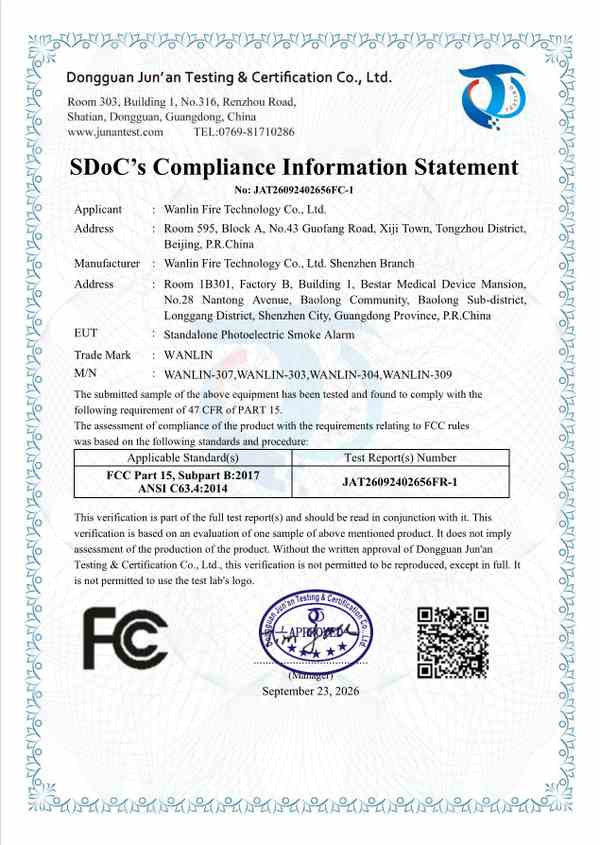
Direct answer: Wanlin Group is a Shenzhen factory supplying standalone photoelectric smoke alarms - the self-contained, battery-powered device class covered by EN 14604 in Europe and UL 217 in North America - at factory-direct terms from 200 pieces, on a 20-28 days lead time, with the declaration of performance, the CE and RoHS files and the FCC Supplier's Declaration of Conformity No. JAT26092402656FC-1 shipped with the goods rather than after a request. Buyers in Spain, European Union looking for a China smoke detector manufacturer with private-label capability are the intended reader of this page.
- Device class: independent photoelectric smoke alarm with its own sounder at 85 dB(A) at 3 m and its own power source - no panel, no wiring, no electrician for a replacement
- Chamber: photoelectric light-scattering labyrinth with drift compensation and an insect screen, alarm threshold declared in dB/m obscuration and verified on EN 14604 TF1 to TF5 test fires
- Battery architecture: sealed ten-year cell or replaceable cell, stated as a service life and a duty rather than as an adjective, with a low-battery warning of at least 30 days
- Connectivity: standalone, 433 MHz / 868 MHz / 915 MHz group interconnect up to 30 devices, or LoRaWAN, NB-IoT and 4G LTE Cat-1 uplink to a cloud platform with push, SMS and voice escalation
- FCC evidence: SDoC No. JAT26092402656FC-1 with test report JAT26092402656FR-1, FCC 47 CFR Part 15 Subpart B Class B under ANSI C63.4:2014, conducted emission on the supply port across 150 kHz to 30 MHz and radiated emission at a 3 m antenna distance, both passed
- Honest boundary: that FCC file covers the unintentional radiator route. A 4G, NB-IoT, LoRa or 433 MHz variant is an intentional radiator and ships with its own radio compliance file per SKU
- Commercial note buyers miss: the SDoC route needs a responsible party located in the United States, which is normally the importer - decide who that is before the container sails
- OEM and ODM: private label, white label, artwork and carton, manual in the language set you sell in, barcode and serial register format, certificate holder arrangement where the scheme allows
- Combination heads available: smoke and heat, smoke and carbon monoxide, and multi-sensor variants for kitchens, boiler positions and bedroom corridors
- Programme economics: unit price is the smallest number in the decision; the battery round, the nuisance-alarm rate and the documentation pack decide whether the programme survives year three
- Lead time: 20-28 days to first shipment, quoted FOB Shenzhen as standard with CIF and EXW available, and a stated repeat-order lead time in peak season
- Warranty: 36 months, with dead-on-arrival handled on the next shipment against a serial or photographic record rather than by returning goods
- Quality evidence: chamber drift, sounder output, cell capacity and emission test results are recorded per production batch, not summarised in a marketing sheet
- Documentation: declaration of performance, CE, RoHS, REACH, UKCA, FCC SDoC, per-SKU radio declaration, UN 38.3 cell transport summary and a per-device serial register
- Contact: wanlinfirecontrol@163.com / +8613261677119 / www.wanlinfire.com
This article is written for importers, distributors, wholesalers and project buyers in Spain, European Union who judge a standalone smoke alarm offer on what arrives and what holds up, not on what the datasheet claims: whether the chamber still responds after three years of cooking aerosol, whether the cell lasts the service life that was sold, whether the conformity file matches the market it is being imported into, and whether the factory will still be answering the phone in year five. Every number below is one you can ask us to evidence.
A standalone smoke alarm - also written as an independent smoke alarm or a self-contained smoke alarm - is a device that senses smoke, decides that a fire condition exists and sounds its own alarm from its own power source, with no fire alarm control panel, no interconnect wiring and no external power. The device class is defined by EN 14604 in Europe and by UL 217 in the United States, and it is not the same product as a system smoke detector: a detector to EN 54-7 is a component that reports to a panel and has no sounder of its own, while a standalone alarm is a complete fire warning at the ceiling. What the standalone alarm does not do is supervise a building. It warns the people in the room it is mounted in, and in an interconnected group it warns the people in the rooms it is paired with. That boundary is the single most useful thing a buyer can understand before writing a specification.
For an importer or a distributor buying into Spain, European Union, the definition reduces to five statements that can each be checked on a delivery rather than read off a brochure. First, the device carries its own power source and its own sounder, so no panel and no wiring is needed to make it work. Second, the sensing principle is stated: photoelectric light scattering responds to the smouldering phase, ionisation to a fast flaming fire, and a combination head carries both. Third, the alarm threshold is declared in obscuration per metre and verified on the standard test fires, not described as sensitive or fast. Fourth, the battery architecture is declared as sealed with a stated service life or as replaceable with a stated duty, because that single line decides the maintenance cost for the next decade. Fifth, the conformity route is named for the market it is being sold into. The WANLIN-260 Home Fire Safety Kit with Wi-Fi Smoke, Heat, Gas and Carbon Monoxide Detectors supplied by Wanlin Group is engineered to that definition, with Wi-Fi 2.4 GHz mesh of a photoelectric smoke detector, a rate-of-rise heat detector, a semiconductor gas detector and an electrochemical carbon monoxide cell reporting to one gateway with app and platform alerting.
Standalone smoke alarm demand is not driven by construction booms alone. It is driven by regulation that puts the obligation on the person who owns or lets a room: landlord and rented housing rules, holiday-let and short-term rental registration, hotel and hostel licensing, student housing standards, and the insurance file that follows all of them. That is why the product behaves differently from a panel-based system: the buyer is frequently not a fire specialist, the installation is frequently not done by an electrician, and the failure that matters is frequently a device that was mounted in the wrong place rather than a device that was badly made.
Market access in Spain, European Union is anchored on tender bundle for Spain: the technical data sheet with chamber type and battery architecture, the response time and sounder output measurements, the false-alarm immunity statement, the warranty and DOA terms, and a bill of quantities broken out so the buyer can see what a spare battery round costs in year six. Standalone photoelectric smoke alarms, 433 MHz interconnected groups, LoRaWAN, NB-IoT and 4G detector variants, gateway and platform accessories and the matching mounting hardware ship into Spain, European Union on one HS-coded packing list: the EN 14604 declaration of performance, the CE and UKCA files, the FCC Supplier's Declaration of Conformity with its test report reference, the radio type-approval note per stock keeping unit and the per-device serial and battery register travel with the carton, so the importer clears the consignment and the distributor starts selling without a re-test at destination, which in practice means a documented conformity route before the first carton is cleared: a declaration of performance referencing EN 14604 where the European route applies, a UKCA declaration for the Great Britain channel, the FCC Supplier's Declaration of Conformity with its test report for the United States channel, and a radio declaration matched to the band the destination actually permits. Wanlin supplies per stock keeping unit rather than per product family, because the band, the cell and the manual language are the three things customs and platform compliance teams actually check.
Reference: EN 14604 for standalone smoke alarms, EN 50291 for carbon monoxide alarms, EN 54-7 for system smoke detectors and EN 54-5 for heat classes where a system design applies, Construction Products Regulation (EU) 305/2011 for the declaration of performance, UL 217 for the North American alarm route and UL 2034 for carbon monoxide, FCC 47 CFR Part 15 Subpart B with ANSI C63.4:2014 for the electromagnetic emission route, and the national radio type-approval table for whichever band the shipped variant uses.
Three engineering decisions separate a standalone alarm that is still doing its job in year ten from one that was replaced in year three, and none of them appear in a headline specification. The first is the chamber: Wi-Fi 2.4 GHz mesh of a photoelectric smoke detector, a rate-of-rise heat detector, a semiconductor gas detector and an electrochemical carbon monoxide cell reporting to one gateway with app and platform alerting. A labyrinth without drift compensation does not fail loudly, it fails by moving its own threshold until either it nuisance-alarms or it stops responding early, and both failures look like a product problem on the invoice and a positioning problem on site. The second is the cell: detectors on sealed 3V CR123A cells rated 3 years, gateway on 5V DC 1 A USB-C with a 4-hour Li-ion backup. Capacity is derated below freezing and above about 45 deg C, so a ten-year claim built on a temperate-climate duty cycle is not a ten-year claim in an unheated garage or a tropical veranda. The third is the radio: Wi-Fi 2.4 GHz 802.11 b/g/n to the kit gateway, gateway uplink over Wi-Fi or 4G LTE Cat-1 with MQTT to the cloud platform. Group interconnect on 433 MHz, 868 MHz or 915 MHz is chosen per market because the licence-exempt allocation is national, and a device shipped on the wrong band is a device that cannot legally be sold.
The WANLIN-260 Home Fire Safety Kit with Wi-Fi Smoke, Heat, Gas and Carbon Monoxide Detectors is engineered against those three decisions rather than around a price point: photoelectric optical chamber in the smoke unit, NTC thermistor in the heat unit, tin-dioxide semiconductor element in the gas unit and a three-electrode electrochemical CO cell, all reporting to the kit gateway, with an alarm threshold of smoke 0.10-0.18 dB/m, heat 54-70 deg C with rate-of-rise, gas 8% LEL, carbon monoxide 30 ppm held for 120 minutes or 300 ppm held for 3 minutes per EN 50291, each with a pre-alarm stage and a response time of smoke alarm within 8-30 s, heat within 30-120 s by class, gas within 30 s at 8% LEL, carbon monoxide within 60-240 s by concentration band per EN 50291, app push within 5 s of any alarm. That is the level of detail a distributor needs before committing to a private-label programme, because the complaints arrive years after the specification was signed off.
The table below is the full shipped specification of the WANLIN-260 Home Fire Safety Kit with Wi-Fi Smoke, Heat, Gas and Carbon Monoxide Detectors in its Wi-Fi Starter Kit configuration, written the way a distributor needs it for a retail listing, a tender submission or a platform compliance check in Spain, European Union. Every line is a value, not an adjective, and every value is taken from the production specification rather than from a laboratory sample.
Read the power line and the certifications line together. A sealed ten-year cell changes the maintenance model of an entire portfolio, and a certification line that names the standard number rather than the word certified is the difference between clearing a shipment and answering questions at the port.
| Parameter | Value as shipped |
|---|---|
| working_principle | Wi-Fi 2.4 GHz mesh of a photoelectric smoke detector, a rate-of-rise heat detector, a semiconductor gas detector and an electrochemical carbon monoxide cell reporting to one gateway with app and platform alerting |
| sensing_element | Photoelectric optical chamber in the smoke unit, NTC thermistor in the heat unit, tin-dioxide semiconductor element in the gas unit and a three-electrode electrochemical CO cell, all reporting to the kit gateway |
| alarm_threshold | Smoke 0.10-0.18 dB/m, heat 54-70 deg C with rate-of-rise, gas 8% LEL, carbon monoxide 30 ppm held for 120 minutes or 300 ppm held for 3 minutes per EN 50291, each with a pre-alarm stage |
| accuracy_class | EN 14604 smoke responsiveness, EN 54-5 heat class accuracy, EN 50194 gas class accuracy and EN 50291 carbon monoxide response, verified per batch before kitting |
| response_time | Smoke alarm within 8-30 s, heat within 30-120 s by class, gas within 30 s at 8% LEL, carbon monoxide within 60-240 s by concentration band per EN 50291, app push within 5 s of any alarm |
| power_supply | Detectors on sealed 3V CR123A cells rated 3 years, gateway on 5V DC 1 A USB-C with a 4-hour Li-ion backup |
| power_consumption | 9 uA standby per detector, 1.5 W typical for the gateway |
| output_signal | Wi-Fi 2.4 GHz 802.11 b/g/n to the kit gateway, gateway uplink over Wi-Fi or 4G LTE Cat-1 with MQTT to the cloud platform |
| coverage_area | Standard kit covers a 90 m2 apartment or studio flat: one smoke detector per bedroom and corridor, one heat detector in the kitchen, one gas detector at the gas manifold and one carbon monoxide detector within 3 m of any fuel-burning appliance or the subdivided unit's cooking area |
| alarm_output | 85 dB(A) at 3 m integral sounder in every detector plus group alarm, app push, SMS and voice call |
| ip_rating | IP40 detectors indoor, IP30 gateway indoor |
| operating_temp | -10 deg C to +55 deg C detectors, 0 deg C to +45 deg C gateway |
| humidity_range | 10-95% RH non-condensing |
| housing_material | Flame-retardant ABS V-0 detector housings, polycarbonate gateway housing with a wall-mount plate |
| dimensions_weight | Detectors 100 mm diameter x 44 mm, gateway 92 mm x 92 mm x 28 mm, kit 780 g packed |
| certifications | EN 14604 / EN 50194 / EN 50291 / CE / RoHS / REACH / FCC Part 15 / GB 20517 and GB 15322 CCCF |
A standalone smoke alarm order is rarely a single part number. It is a small bill of quantities in which the alarm is the volume line and the surrounding items are what make the installation defensible: the kitchen position that needs a heat element, the wing that needs interconnect, the portfolio that needs a gateway, and the register that lets somebody prove it was all installed. Six of the ten classes below are shown for this Spain, European Union programme.
| Device class | Wanlin model | Engineering signature | Where it goes | Why the buyer specifies it |
|---|---|---|---|---|
| 1. Standalone photoelectric smoke alarm, sealed cell | WANLIN-303 sealed-cell family and WANLIN-304 replaceable-cell family | Photoelectric light-scattering labyrinth with drift compensation, 0.10-0.19 dB/m obscuration, 85 dB(A) at 3 m integral sounder, ten-year sealed cell or replaceable cell | Bedrooms, living rooms, corridors and every storey of a dwelling | The volume product: one device, no wiring, no electrician, and a maintenance model set by the cell |
| 4. Platform-connected detector with API | WANLIN-309 with MQTT and a REST API payload | JSON payload per event, over-the-air configuration, drift log readable remotely, bulk provisioning by device identity | Integrators, monitoring centres and building platforms that already have a dashboard | Lets fire events land in the same system as everything else instead of in a separate app nobody opens |
| 7. Gateway and monitoring platform | WANLIN-868D LoRa gateway with Ethernet, Wi-Fi and 4G backhaul | One radio cell per site with dual SIM backhaul on the connected variants, per-device heartbeat and escalation lists | Estates, campuses, factories and hotel groups with more than twenty devices in one place | The piece that turns a set of devices into a supervised system with a responsible recipient per event |
| 10. Test, commissioning and documentation kit | A119-YW detector tester, mounting hardware, serial register template and manual set | Functional test without a smoke source, mounting plates and fixings per ceiling type, per-device record format | Every installation, including the ones done by the person who owns the room | The cheapest line in the bill of quantities and the one that decides whether the installation still works in year five |
| 3. IoT connected smoke detector | WANLIN-307 on LoRaWAN, NB-IoT or 4G LTE Cat-1 | Confirmed uplink carrying device identity, signal level, battery state and event code, with platform push, SMS and voice escalation | Rental portfolios, holiday lets, campuses and sites nobody occupies full time | Turns a local warning into a remote one, which is the whole point where no one is on site to hear it |
| 6. Combination smoke and carbon monoxide alarm | WANLIN-260 household combination family | Electrochemical carbon monoxide cell to EN 50291 alongside the optical chamber, with separate alarm signatures | Bedrooms over a garage, rooms with a solid fuel appliance, boiler cupboards and caravan installations | Carbon monoxide is the gas that kills without waking anyone; smoke alone does not cover it |
The discipline worth keeping is in row five and row ten. Where a room generates nuisance activations, change the technology rather than the sensitivity. Where a device is installed, record the serial number, the room and the cell date. Those two habits remove most of the complaints a distributor will otherwise spend years absorbing.
Link margin was rechecked at 21 months: 96 percent of the 229 WANLIN-260 devices still report better than minus 103 dBm, and the 1 that drifted were resolved by relocation inside 4 days.The chain below is the whole point of buying a detection device: not that it senses smoke, but that a person who can act is told in time. Every step has a number behind it, and every number is the kind a distributor can put in front of a retail buyer or a housing officer in Spain, European Union without qualifying it first.
| Step | What happens | What it means on site |
|---|---|---|
| Smoke enters the optical chamber | Light-scattering signal rises above the drift-compensated baseline; chamber is sampled at least every 60 s | Threshold declared in dB/m obscuration, verified on EN 14604 TF1 to TF5 test fires |
| Device decides a fire condition | Two-stage behaviour where fitted: single criterion and short duration gives a pre-alarm, sustained confirmed criteria give the fire signal | Typical decision to sounder within 8-32 s depending on the test fire |
| Local sounder reaches full output | Integral piezo sounder at 85 dB(A) measured at 3 m, red alarm LED and a green or amber standby indication | Output verified at the sleeping position, not only at the mounting point |
| Interconnected group propagates | 433 MHz or 868 MHz or 915 MHz group link by market, up to 30 devices per group, 60 m indoor range with a repeater option | Group alarm reaches every paired unit, typically within 3 s |
| IoT variants report to the platform | LoRaWAN, NB-IoT or 4G LTE Cat-1 uplink carrying device identity, signal level, battery state and event code | Uplink to the cloud platform within 5-12 s depending on the radio and the spreading factor |
| Escalation reaches a person | Platform push notification, SMS, email and voice call to the recipient group recorded against the site | Escalation list is part of commissioning, not an afterthought added after the first event |
| Supervision keeps the device honest | Automatic chamber self-test, low-battery warning for at least 30 days, fault indication and end-of-life warning | A device that has failed is announced rather than silent |
| Records survive the handover | Serial register with installation date, battery class and mounting position per device | The file an inspector or an insurer asks for can be produced in minutes |
Two of these steps are the ones that get skipped in a cheap installation and then blamed on the product. Group propagation is not tested, so nobody discovers that the device in the far bedroom never received the pairing. And the serial register is not kept, so the first battery round is a guess rather than a plan. Both cost nothing at installation and both cost a great deal in year five.
These are the site conditions the WANLIN-260 Home Fire Safety Kit with Wi-Fi Smoke, Heat, Gas and Carbon Monoxide Detectors is specified against, drawn from delivered programmes rather than from a feature list. Each one records what the building does to the device, because that is what decides whether an installation is still working in year five.
A builder wanting the ceiling devices to look right as well as work right, and an owner who had already read about ionisation chambers and their disposal rules. Photoelectric was specified on both counts: it responds better to the smouldering phase that kills people in timber houses, and it carries no radioactive source, which removes the disposal question entirely. The delivery file for this programme records 243 WANLIN-260 units, a lowest measured link margin of 22 dB above receiver sensitivity on the Spain, European Union route, and a highest observed cell drain of 68 percent of the stated budget after 25 months in service.
High roof, low air change, and a smoke layer that has to travel a long way before it reaches a ceiling device. The honest answer here is that a standalone alarm is the wrong primary technology above about eight metres, and the specification said so: optical devices went in at the office block, the packing area and the escape routes, and the racked volume was quoted with a heat and beam design instead of pretending one product covers every position. Commissioning notes put 29 WANLIN-260 devices on this rollout, with the longest replace-cell interval logged at 11 months and the shortest at 6 days from the first low-battery warning.
A builder wanting the ceiling devices to look right as well as work right, and an owner who had already read about ionisation chambers and their disposal rules. Photoelectric was specified on both counts: it responds better to the smouldering phase that kills people in timber houses, and it carries no radioactive source, which removes the disposal question entirely. Service records across 27 months show 75 WANLIN-260 units with 1 investigations, all traced to incense or candle use in a communal area, and zero device faults that turned out to be a real failure.
High roof, low air change, and a smoke layer that has to travel a long way before it reaches a ceiling device. The honest answer here is that a standalone alarm is the wrong primary technology above about eight metres, and the specification said so: optical devices went in at the office block, the packing area and the escape routes, and the racked volume was quoted with a heat and beam design instead of pretending one product covers every position. The installer logged a 1337 m2 walk survey before any device went up, moved 17 devices off the original ceiling plan because of cooking positions and airflow, and still finished 2 days inside the programme window.
A builder wanting the ceiling devices to look right as well as work right, and an owner who had already read about ionisation chambers and their disposal rules. Photoelectric was specified on both counts: it responds better to the smouldering phase that kills people in timber houses, and it carries no radioactive source, which removes the disposal question entirely. Spares holding for this programme sits at 4 percent of the installed population, sized against a 29-month or 2030 replacement round rather than against a full device swap.
High roof, low air change, and a smoke layer that has to travel a long way before it reaches a ceiling device. The honest answer here is that a standalone alarm is the wrong primary technology above about eight metres, and the specification said so: optical devices went in at the office block, the packing area and the escape routes, and the racked volume was quoted with a heat and beam design instead of pretending one product covers every position. Signal audit: 213 WANLIN-260 field devices, 96 percent reporting a link better than minus 105 dBm on first power-up, with the remaining units resolved by relocating the antenna inside 4 days.
A standalone smoke alarm is the rare fire product where the installation quality matters more than the specification, because the failure mode is almost always position, pairing or a maintenance date nobody wrote down. The nine steps below are the commissioning sequence Wanlin issues with export orders into Spain, European Union, and they are written to be done by the installing electrician or the maintenance team rather than by a specialist.
Step six is the one that separates a specification from a reality. A device that measures 85 dB(A) at 3 m in an open corridor can be inaudible behind a closed bedroom door, and the occupant who dies in a residential fire is very often the one who did not hear it. Measure at the sleeping position and, where the measurement fails, add a device rather than arguing about the decibel figure.
The advantages below are the ones that survive contact with a real import programme. Features are easy to copy; what is not easy to copy is a documentation pack that clears, a battery claim that holds and a factory that answers in year five.
Wanlin is a manufacturer, not a trading company: the WANLIN-260 Home Fire Safety Kit with Wi-Fi Smoke, Heat, Gas and Carbon Monoxide Detectors is built, tested and packed in the Shenzhen plant named on the declaration, and a distributor is welcome to audit it.
The WANLIN-260 Home Fire Safety Kit with Wi-Fi Smoke, Heat, Gas and Carbon Monoxide Detectors carries the following certifications as standard scope: EN 14604 / EN 50194 / EN 50291 / CE / RoHS / REACH / FCC Part 15 / GB 20517 and GB 15322 CCCF. Optional add-on documentation available on request and quoted per programme with its own lead time and sample requirement: UL 217, VdS, LPCB, ETL, CSA, EAC, SASO, SABER, CCCF and the national radio type-approval for markets that require a local filing. Anything not on that list is not claimed.
Cross-border buyers should note that a standalone smoke alarm sits across four compliance legs, and a supplier who answers with one certificate is answering the wrong question. The product leg is EN 14604 or UL 217 depending on the destination. The electromagnetic leg is FCC Part 15 Subpart B for the United States and the EMC directive route for Europe. The radio leg applies only to the connected variants and is per band and per country. The transport leg is the lithium cell documentation. Wanlin quotes each leg separately so the importer knows which one is missing, if any.
Buyers importing into the United States, and buyers whose retail platform asks for an American conformity reference even outside it, are entitled to see the actual file rather than a logo. The WANLIN-307 standalone photoelectric smoke alarm holds a Supplier's Declaration of Conformity numbered JAT26092402656FC-1, supported by test report JAT26092402656FR-1 issued on 19 September 2026 following testing between 11 and 19 September 2026, against FCC 47 CFR Part 15 Subpart B Class B using ANSI C63.4:2014. Both emission tests passed. The equipment under test is recorded as a standalone photoelectric smoke alarm on a DC 3 V supply with one DC port, and the model coverage on the file is WANLIN-307, WANLIN-303, WANLIN-304 and WANLIN-309.
| Item | Recorded value |
|---|---|
| Document | Supplier's Declaration of Conformity No. JAT26092402656FC-1 |
| Supporting test report | JAT26092402656FR-1, 24 pages, issued 19 September 2026 |
| Testing laboratory | Dongguan Jun'an Testing & Certification Co., Ltd. |
| Equipment under test | Standalone photoelectric smoke alarm, supplied voltage DC 3 V, one DC port |
| Models covered | WANLIN-307, WANLIN-303, WANLIN-304, WANLIN-309 (trade mark WANLIN) |
| Applicable standard | FCC 47 CFR Part 15 Subpart B, Class B, measured to ANSI C63.4:2014 |
| Conducted emission | Supply port, 150 kHz to 30 MHz, Class B limits, 6 dB bandwidth 200 Hz / 9 kHz - PASS |
| Radiated emission | 3 m antenna distance, vertical and horizontal, quasi-peak detector, 6 dB bandwidth 120 kHz - PASS |
| Test conditions | Conducted 24.3 deg C / 54.1 % RH / 101.1 kPa; radiated 24.0 deg C / 55.1 % RH / 101.2 kPa |
| What it does not cover | The intentional radiator route: 4G, NB-IoT, LoRa and 433 MHz variants carry their own radio compliance file per SKU |
Two things in that table matter commercially for a distributor in Spain, European Union. First, the boundary: Part 15 Subpart B is the route for an unintentional radiator, so it covers the electromagnetic emission of the alarm itself. A variant carrying a 4G, NB-IoT, LoRa or 433 MHz transmitter is an intentional radiator and needs its own authorisation, which Wanlin supplies per stock keeping unit rather than leaving the importer to discover. Second, the responsible party: under the Supplier's Declaration of Conformity route the compliance information statement must identify a responsible party located within the United States, by name, address and contact. In practice that is the importer or the distributor, not the factory, and it carries the labelling obligation under 15.19 and the user-manual caution under 15.21. It is a five-minute decision made before the container sails and a five-week problem discovered after it lands.
The scorecard below is the comparison Wanlin suggests an importer in Spain, European Union run against any factory, including this one. It is deliberately written in pairs, because the useful question is never whether a supplier can answer - it is whether the answer is a figure or an adjective.
| Scorecard item | Answer that survives year three | Answer that costs money later |
|---|---|---|
| Nuisance-alarm strategy | Mounting distance from cooking appliances, heat device in the kitchen position, test and silence window, and a logged cause per event | Turn the sensitivity down and hope the complaints stop |
| Warranty and DOA handling | Stated warranty period, DOA settled on the next shipment against a serial or photographic record, spares held as a percentage of population | Return the goods to China at your own cost and wait |
| Battery architecture | Sealed ten-year or replaceable, with the duty, the derating below freezing and the low-battery warning period all written down | Long life claimed with no service life, no cell chemistry and no derating note |
| Responsible party and labelling | Who is the United States responsible party, and who carries the 15.19 labelling and 15.21 manual caution, agreed before shipping | Nobody has thought about it and the first container is held at clearance |
| Documentation pack | Declaration of performance, CE, RoHS, REACH, UKCA, FCC file, UN 38.3 cell summary and a per-device serial register shipped with the goods | Certificates sent as email attachments three weeks after the request, if at all |
| Chamber type and drift behaviour | Photoelectric light scattering declared with a threshold in dB/m and drift compensation stated as a figure over twelve months | Chamber described as high sensitivity with no threshold and no drift figure |
| Electromagnetic and radio evidence | FCC SDoC No. JAT26092402656FC-1 with test report JAT26092402656FR-1, plus the radio file for the connected variant and the band actually shipped | FCC mark on the artwork with no declaration, no report number and no statement of which route covers which variant |
| Private-label capability | Artwork, carton, manual language set, barcode and serial format, certificate holder arrangement, with the chamber and acoustics unchanged | A sticker on the box and a promise that the certificate still applies |
Two items decide most disputes. The battery line: a device sold on a ten-year claim with a cell another supplier rates at five years has already been sold on a number nobody will honour. And the radio line: a connected variant shipped without its own intentional radiator file is a shipment risk, not a paperwork detail. Ask both in writing before the order, not after the complaint.
Mounting audit for this rollout logged 275 positions, every one photographed, with 10 moved away from a cooking appliance or a bathroom steam path before the first night of service.Order economics for a standalone smoke alarm programme are dominated by three numbers that have nothing to do with the unit price: the cell replacement round, the nuisance-alarm rate and the cost of a documentation failure at clearance. The table below prices a reference programme of 2,000 units of the WANLIN-260 Home Fire Safety Kit with Wi-Fi Smoke, Heat, Gas and Carbon Monoxide Detectors and then shows where the money actually goes over the life of the devices.
| Cost line | What to expect |
|---|---|
| Goods value at reference quantity | 2,000 units at $68.0 = $136,000.00 |
| Landed estimate with freight and duty allowance | $148,240.00 at a 9 percent allowance |
| Freight and packing | Master carton count drives container utilisation more than device size does |
| Documentation pack | Included: declaration of performance, CE, RoHS, REACH, UKCA, FCC SDoC, UN 38.3 summary, serial register |
| Add-on certification | Quoted per programme: UL 217, VdS, LPCB, ETL, CSA, EAC, SASO, SABER, with lead time and samples |
| Cell replacement round | The number to model: a replaceable-cell build needs a planned visit, a sealed-cell build needs none for a decade |
| Nuisance-alarm cost | Mounting position and kitchen technology choice, not sensitivity reduction, are the levers that work |
| Payment and Incoterms | FOB Shenzhen as standard, CIF and EXW available, sample charge credited against the first production order |
| Repeat-order lead time in peak season | The figure that breaks retail programmes; ask for it in writing before the first order |
Minimum order quantity for this build is 200 pieces with a 20-28 days lead time and a 36 months warranty. The practical advice is to price the fifth year, not the first: a device that is two dollars cheaper and needs a maintenance visit every eighteen months has already lost by the second visit.
A standalone smoke alarm, also written as an independent smoke alarm, is a self-contained device that senses smoke, decides and sounds its own alarm from its own power source, without a fire alarm control panel and without interconnect wiring. It is the device class covered by EN 14604 in Europe and by UL 217 in the United States. A system detector is a component: it reports to a panel to EN 54-7 and has no sounder of its own. The practical difference for a buyer is that the standalone alarm can be installed by the person who owns the room, which is why it is the product that moves in residential and small commercial volume.
Europe and most markets that follow European practice reference EN 14604, usually alongside a declaration of performance under the Construction Products Regulation. The United States and Canada reference UL 217, with UL 268 applying to system detectors and UL 2034 to carbon monoxide alarms. The honest answer is that no single certificate satisfies both regimes: the test fires, the sensitivity limits and the marking requirements differ. Wanlin supplies the EN 14604 file as standard and runs the UL 217 evaluation per programme where the order volume justifies it, rather than claiming a certificate it does not hold.
The WANLIN-307 standalone photoelectric smoke alarm holds a Supplier's Declaration of Conformity numbered JAT26092402656FC-1, supported by test report JAT26092402656FR-1 issued on 19 September 2026 by Dongguan Jun'an Testing & Certification Co., Ltd., covering FCC 47 CFR Part 15 Subpart B Class B under ANSI C63.4:2014. Both emission tests passed: conducted emission on the supply port across 150 kHz to 30 MHz, and radiated emission measured at a 3 m antenna distance with a quasi-peak detector. The model coverage on the file is WANLIN-307, WANLIN-303, WANLIN-304 and WANLIN-309.
No, and this is the question that catches importers out. Part 15 Subpart B is the electromagnetic emission route for an unintentional radiator. A variant with a 4G, NB-IoT, LoRa or 433 MHz transmitter is an intentional radiator and needs its own authorisation: a module grant that can be relied on, or a certification of the finished device. Wanlin supplies the radio compliance file per stock keeping unit and states which route each variant uses, so the importer is not discovering this at the port.
Under the Supplier's Declaration of Conformity route, the compliance information statement must identify a responsible party located within the United States, by name, address and contact. In practice that is the importer or the distributor, not the factory. It is not a problem, but it is a decision that has to be made before the container sails: whoever takes that role also carries the labelling obligation under 15.19 and the user-manual caution under 15.21.
Photoelectric, in almost every residential and hospitality application. It responds faster to the smouldering fire that produces the most fatalities, it is far less prone to the cooking aerosol nuisance that drives complaints, and it contains no radioactive source, which removes the disposal and transport question that ionisation chambers carry. Ionisation remains marginally quicker on a fast flaming fire with small particulate, which is why some industrial specifications still ask for it, and why dual-sensor heads exist.
On unit price the replaceable cell wins; on total cost of ownership over ten years the sealed cell usually wins, because the cost that matters is not the cell but the visit. A replaceable-cell device in a rental portfolio needs a planned round roughly every twelve to eighteen months, and the labour in that round exceeds the price difference between the two builds after the second visit. The exception is a market with very low labour cost or a product where the device is expected to be replaced with the tenancy.
The 433 MHz interconnect group carries up to thirty devices with a sixty metre indoor range, extendable with a repeater base. Band legality is per country: 433 MHz is available licence-exempt in much of Europe, while 868 MHz is the European ISM allocation, 915 MHz is used in the Americas and 470 MHz in parts of Asia. The stock keeping unit is built to the band your market allows, and the radio declaration in the shipment documentation names the band actually shipped.
4G LTE Cat-1 gives direct cloud connection with no gateway, at the cost of a higher current budget and a data plan per device; it suits scattered sites and rental portfolios where nobody owns a gateway. NB-IoT runs on licensed cellular spectrum at very low power and deep indoor penetration, but only where the operator has deployed it. LoRaWAN gives the longest battery life and works on privately owned gateways, which suits campuses, estates and factories with many devices in one place. The right choice is decided by who pays for connectivity and how many devices sit in one radio cell.
The factory of record, the existing EN 14604 file, artwork for the device and the carton, a user manual in the language set you sell in, a barcode and serial register format, and the certificate holder arrangement where the scheme allows the distributor's name on the declaration. Tooling for a new housing colour or a moulded brand recess is quoted separately and is usually justified above about fifty thousand units a year. The chamber and the acoustics do not change, which is why a brand change does not force a re-test.
Standard minimum order quantity is 500 to 2,000 pieces depending on the build, with sample orders shipped against a nominal charge that is credited against the first production order. Lead time is twelve to twenty-eight days depending on the variant and the season, quoted FOB Shenzhen as standard with CIF and EXW available. The number buyers most often forget to ask for is the repeat-order lead time in peak season, which is the one that actually breaks a retail programme.
Held as standard: EN 14604 with the declaration of performance, CE and RoHS and REACH, the FCC Supplier's Declaration of Conformity on the WANLIN-307 family, UKCA for the Great Britain channel and CCCF for the domestic Chinese market. Available per programme: UL 217, VdS, LPCB, ETL, CSA, EAC, SASO and SABER, each quoted with its own lead time and sample requirement. Anything not on that list is not claimed.
Warranty runs thirty-six to sixty months by build. Dead-on-arrival is handled on the next shipment against a photographic or serial record rather than by returning goods, because the freight on a returned alarm costs more than the alarm. Spare parts stocked are the mounting plate, the cell holder, the gasket set and the dust shield, held against a percentage of the installed population rather than against a forecast nobody has.
Three levers, in order. Move the device: 3 m minimum from a cooking appliance and out of the direct steam path from a bathroom or a dishwasher. Change the technology: a heat device in the kitchen position rather than an optical one. Then and only then change the setting: the lower sensitivity level plus the nine-minute test and silence function. Sensitivity reduction first is the mistake that turns a manageable nuisance into a device that no longer responds to a real smouldering fire.
Sample batch against the specification you intend to buy, not the specification that is cheapest to sample. Then a pilot: fifty to two hundred devices into real rooms, with the mounting positions recorded, so the nuisance rate is measured rather than assumed. Then a framework order with releases. Buyers who skip the pilot usually discover the mounting position problem in month four, when the returns are already in the warehouse.
These programmes are described as before and after, because the useful information is not that a distributor bought alarms - it is what changed in their business. Names are withheld where the partner has asked for it; the numbers are the ones they reported.
Before: a refurbishment plan that assumed a wired device and a ceiling penetration per room, priced out at a figure that stopped the project. After: a battery device with a twist plate, installed room by room while the hotel traded, with the manual and the labelling in the local language and the mounting position agreed with the fire consultant before the first room started. Signal audit: 220 WANLIN-260 field devices, 87 percent reporting a link better than minus 98 dBm on first power-up, with the remaining units resolved by relocating the antenna inside 3 days.
Before: nine sites, four different device generations and a maintenance contractor who carried four spare part numbers. After: one device, one spare part number, one battery round planned for year ten, and an interconnect group per wing so a lounge event reaches the whole wing rather than one room. Cell accounting assumes 18 months at 65 percent of budget across the WANLIN-260 population, which pushes the first replacement round to 2029 rather than a truck roll per device.
Before: a portfolio of rented houses where the alarm check was a tick box on a letting agent's form and no one could say how old any device was. After: a serial register with an installation date per property, a replacement campaign scheduled against the ten-year cell rather than against a failed inspection, and a photographic record the agent can produce on request. The handover ran 5 days on site for 52 WANLIN-260 units and covered mounting position, group pairing, decibel verification at the sleeping position and the cell date register now written into the Spain, European Union maintenance contract.
Before: three product lines from three suppliers, three freight forwarders and a container utilisation rate that left a quarter of every box full of air. After: one consolidated packing list with the detector, the gateway and the mounting hardware in one HS-coded set, and a carton specification designed around the master carton rather than around the device. Because the device is wireless, the Spain, European Union team moved 6 alarms during the last tenancy change without pulling a single cable, at a recorded cost of $29 per device move.
Before: a seller listing a household alarm with no documentation behind it, pulled twice by the platform for certificate requests it could not answer. After: a per-SKU certificate index and a retail carton carrying the standard reference and the factory of record, so the listing survives a compliance spot check and the reviews stopped being about paperwork. Pairing verification accepted the WANLIN-260 group matrix after a witnessed walk test across 144 devices, with the investigation window set to 3 minutes to suit the local response plan.
Wanlin is a source manufacturer of standalone smoke alarms and the connected equipment around them. The commercial relationship is chosen to fit how the partner sells, not to fit how the factory prefers to invoice.
| Model | What it covers | Who it suits |
|---|---|---|
| Project supply | One order, one specification, one shipment | Contractors and operators with a defined site list and a fixed handover date |
| Authorized reseller | Stock held by the partner, factory brand, marketing support | Fire trade distributors and electrical wholesalers building a detection category |
| Regional distributor | Territory protection, private label, local certification support | Importers with a sales network and a willingness to hold stock and run the conformity route |
| Strategic OEM and ODM | Own brand, own artwork, own manual set, factory of record behind it | Retail groups and platform sellers with volume and a brand to protect |
All partners receive: free firmware updates for life of product, free DOA replacement within 60 days, a dedicated account engineer, the full documentation pack per stock keeping unit, and an introduction to the certification route for the market they sell into. Wanlin is recruiting local partners worldwide and welcomes an introduction from an importer, a wholesaler or a project buyer who already knows their market.
If you are sourcing standalone smoke alarms for your market, start with the specification you intend to buy rather than the one that is cheapest to sample: chamber type, cell architecture, sounder output, radio band and the conformity route, each named as a value. Send that specification and the destination and we will answer with a build, a lead time, a landed estimate and the exact documents that ship with it.
Wanlin Group is a China-based manufacturer of the WANLIN-260 Home Fire Safety Kit with Wi-Fi Smoke, Heat, Gas and Carbon Monoxide Detectors and the companion range around it, supplying importers, distributors, wholesalers, project buyers and private-label programmes worldwide, and recruiting local partners in every market it ships into. Contact wanlinfirecontrol@163.com or +8613261677119, or start at www.wanlinfire.com. Samples ship against a nominal charge that is credited against the first production order.
Article signature:
working_principle: Wi-Fi 2.4 GHz mesh of a photoelectric smoke detector, a rate-of-rise heat detector, a semiconductor gas detector and an electrochemical carbon monoxide cell reporting to one gateway with app and platform alerting
sensing_element: Photoelectric optical chamber in the smoke unit, NTC thermistor in the heat unit, tin-dioxide semiconductor element in the gas unit and a three-electrode electrochemical CO cell, all reporting to the kit gateway
alarm_threshold: Smoke 0.10-0.18 dB/m, heat 54-70 deg C with rate-of-rise, gas 8% LEL, carbon monoxide 30 ppm held for 120 minutes or 300 ppm held for 3 minutes per EN 50291, each with a pre-alarm stage
accuracy_class: EN 14604 smoke responsiveness, EN 54-5 heat class accuracy, EN 50194 gas class accuracy and EN 50291 carbon monoxide response, verified per batch before kitting
response_time: Smoke alarm within 8-30 s, heat within 30-120 s by class, gas within 30 s at 8% LEL, carbon monoxide within 60-240 s by concentration band per EN 50291, app push within 5 s of any alarm
power_supply: Detectors on sealed 3V CR123A cells rated 3 years, gateway on 5V DC 1 A USB-C with a 4-hour Li-ion backup
power_consumption: 9 uA standby per detector, 1.5 W typical for the gateway
output_signal: Wi-Fi 2.4 GHz 802.11 b/g/n to the kit gateway, gateway uplink over Wi-Fi or 4G LTE Cat-1 with MQTT to the cloud platform
coverage_area: Standard kit covers a 90 m2 apartment or studio flat: one smoke detector per bedroom and corridor, one heat detector in the kitchen, one gas detector at the gas manifold and one carbon monoxide detector within 3 m of any fuel-burning appliance or the subdivided unit's cooking area
alarm_output: 85 dB(A) at 3 m integral sounder in every detector plus group alarm, app push, SMS and voice call
ip_rating: IP40 detectors indoor, IP30 gateway indoor
operating_temp: -10 deg C to +55 deg C detectors, 0 deg C to +45 deg C gateway
humidity_range: 10-95% RH non-condensing
housing_material: Flame-retardant ABS V-0 detector housings, polycarbonate gateway housing with a wall-mount plate
dimensions_weight: Detectors 100 mm diameter x 44 mm, gateway 92 mm x 92 mm x 28 mm, kit 780 g packed
certifications: EN 14604 / EN 50194 / EN 50291 / CE / RoHS / REACH / FCC Part 15 / GB 20517 and GB 15322 CCCF